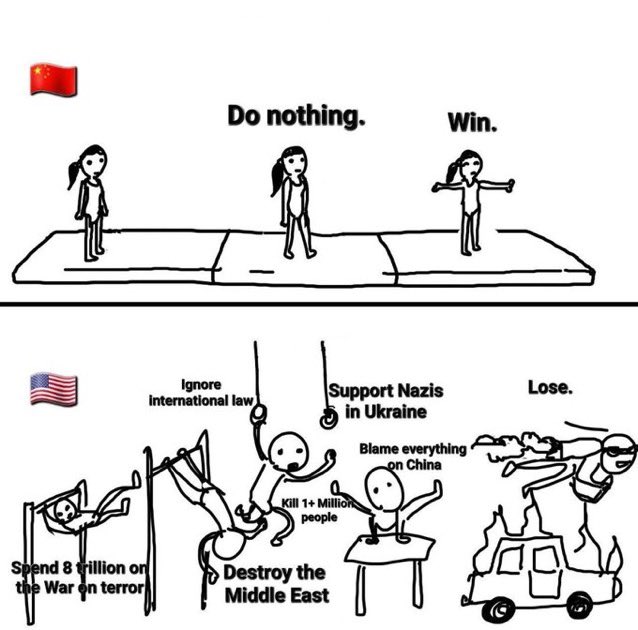
Do nothing. Win: The US, China, and 21st Century Global Power

I’m sure that some of you have seen the meme of the US gymnast that engages in all manner of feats, while a Chinese gymnast does nothing and still wins. It is so very interesting to me how the current administration is manifesting this very reality.

We are learning that China’s universities are increasingly surpassing the US, which only makes sense if you consider the irrational hostility of the administration to science and its cancellation of millions of dollars in research funds. Who did this benefit?

The global energy crisis that the US and Israel have created has inadvertently created a boon for Chinese automaker BYD, the world’s largest manufacturer of electric vehicles. Bear in mind that the US government not only ended subsidies to support EV sales, but also has lowered fuel economy standards as a gift to fossil fuel companies. Was this a choice that enhanced US international competitiveness in the auto sector? Or was it instead another backwards-facing decision based on myopia?

The current administration has also attacked projects and subsidies focused on renewable energy. This is despite the fact that climate change threatens species extinction (a scientific reality which the current administration rejects). However, its short-sightedness has, once again, proved beneficial to China who has not only expanded its adoption of renewable energy, but is also a global leader in manufacturing in this domain. Is governance in the interest of the short-term profits of the fossil fuel industry in the best interest of society as a whole?

As an aside, some commentators have pointed out that while the US is run by people whose expertise lies in law and finance, China is run by engineers. If true, this is a damning insight into the kind of interests and logics which dominate systems of governance in the US given its increasingly sad outcomes.

Lastly, the US empire’s over-reliance of sanctions and use of financial coercion to sustain dollar-dominance appears to be unraveling. Not only has Iran been demanding payments in Chinese Yuan for safe passage through the Strait of Hormuz, I am now hearing that Russia is demanding Yuan from European nations who are, due to the current crisis, returning to it as a supplier. Hence, the overuse of the sanctions as an instrument of coercive control led to the creation of alternative vehicles, a process which increasingly appears to be oriented towards China.

Again, China doesn’t have to invade or bomb other countries, destroy their economies or assassinate their leaders, it doesn’t even need to meddle in their elections and finance insurgents to gain power. And it is precisely because it has eschewed this path, focused on technological development, manufacturing and construction, trade, and diplomacy that it has and will continue to prevail.

The US elite, by contrast, has been driven by an insatiable desire for dominion over the world. Such power, if attained, is doomed to fall. A Mandinka proverb tells us, “Niŋ i lafitaa a bee la, i ka fo a bee le la,” that is, “If you want all, you lose all.” Not only is US power finite, as is all power, the increasingly desperate actions taken to sustain it will only accelerate its decline.

Unchanging Sameness

This is a good reminder of how much Black political discourse over the last decade–with its emphasis on “representation” and the fetishization of secondary and tertiary identities–was ultimately vacuous. Far too many people ceased to be concerned with social change or even the acquisition of power, but rather with hyperindividualistic acquisitiveness within the neoliberal order. Black “activists” reveled in fashionable and vociferous (but impotent) rhetoric yet eschewed the lessons of Malcolm X and others that correctly identified our condition as internal colonialism, and also posed solutions to it (territorial sovereignty). Hence, in turning away from the historic traditions of Black radicalism, many instead embraced Western liberal theories–ideas that have proven incapable of even freeing whites from the thrall of capitalism or growing authoritarianism.

We were never going to sing, march, or boycott our way to freedom. We certainly weren’t going to twerk our way to it. Now that all of these illusory paths have exhausted themselves, perhaps we can take the path less traveled.

Culture and revolution

Cedric Robinson wrote that revolutionary movements are a signifier of a broader cultural orientation towards resistance. Values such as group solidarity, sharing of resources, communal ethics, and so on, while not revolutionary in and of themselves, provided the foundation for the revolutionary movements of the 1960s and 1970s.

This reflected Cabral’s thesis that the culture of a people is the principle basis upon which the struggle for independence is sustained, as well as the need for cultural dissimilarity between the oppressor and the oppressed. The latter serves as a point of demarcation in terms of the values, practices, and beliefs of a people—elements which also stimulates a people’s consciousness of the need for struggle—not only for the establishment of territorial sovereignty, but also to create those social conditions wherein their culture can thrive.

Values of the kind noted above, once salient in the culture of Africans in the US, have been thoroughly corrupted and eroded over the last six decades. The last three decades in particular have evidenced a thrust towards cultural assimilation (one that is couched in discourse of progressivism of late), which is nonetheless destructive to our ethos and social capacity.

Consequently, I do not believe that the cultural conditions exist to create leaders like Malcolm X, Huey Newton, Fred Hampton, Assata Shakur, or Robert Williams today, not on a mass scale in any event. The emergence of critical intelligence of that kind is augmented by the extant organizational and communal infrastructure, and this infrastructure has been systematically dismantled in recent decades. It has been supplanted by atomistic individualism, the celebration of material excess, the valorization of amorality, and neoliberalism. In short, a culture of counterrevolutionary norms and values.

Wars and Rumors of Wars

Can you hear that sound? That drumming?

Those are war drums being beaten.

Do you see who’s playing them? Do they look familiar to you?

They should. That’s the Western, capitalist elite. For them war, chaos, terror, and death is just a business opportunity. That’s for them. The dying part, that’s for you.

Can you see those lines? The ones being drawn between different blocs of allies?

Notice how former alliances are dissolving and new ones are being forged; how fading powers, desperate to cling even to the shadow of power, have grown more and more desperate–more and more bellicose.

Can you see that sign up ahead? The one that reads “Caution”? The one that’s being ignored because avarice and hubris are a dangerous combination?

We are being ushered into a world where danger and uncertainty will crest, giving rise to one where suffering and destruction become general, rather than particular conditions.

This is the world born of the savagery of colonialism and slavery and the avarice of their progeny–capitalism. This is the world as is it and as it will be, that is, until we decide to do something about it.

The Fashion of Pseudo-Radicalism and the Myopia of Contemporary Social Movements

I am continually intrigued by the “activism” of the last decade with its emphasis on an imagined purity, either of the ideological or of the blood quantum variety. These corresponding movements generally failed to either forge novel criticisms of or strategies against any forms of structural oppression (i.e., racism, capitalism, colonialism, imperialism), to provide the kind of political education that truly revolutionary movements require, or to effectively marshal the masses in opposition to these forces.

For example, has the preponderance of “anti-racist” activism or writing served to illuminate paths to reform which were not solely reliant on either a sympathetic administration or the largess of white liberals or institutions? Did these movements articulate an end goal short of structural integration within a settler colonial state or the cultural assimilation of all elements within their communities to white progressive views, values, and objectives? Both questions can be answered definitively in the negative. And how could they when their end goals consisted of puerile ends such as “representation” in corporate mass media or “delineation” from other African and African Diasporic populations. As such, these movements captured mental energy and material resources which should have served more revolutionary purposes, yet in the end either expended such potentiality into the ether or enriched their figureheads.

Though they failed in substantive ways, these movements did succeed in advancing the cause of atomization (i.e, division) in spectacular fashion. This atomization has been so thorough that it has served to estrange elements among us in the present-day, as well as severing vital linkages to our past struggles which could serve to guide our actions.

The lesson which I maintain should be learned from this period and its myopia is captured by and Ewe proverb which states, “Ŋkuagbãtɔ mekplɔa aʋa o,” that is, “The blind does not lead in a battle.” This teaches us that those of limited vision should never be entrusted to guide others. Further, it illustrates the fallacy of seeking to conceive of any liberatory project de-linked from the dynamic history of revolutionary struggle which has been forged by our ancestors. In my book,Jacob H. Carruthers and the Restoration of an African Worldview, I discuss the failings of these contemporary movements in contrast to the victorious Haitian Revolution.

“These contemporary movements do not seek to avenge the wrongs perpetrated against African people over centuries, or to ‘conquer or die,’ and in so doing to topple the oft-lamented system. Instead, they seek reconciliation with that system or inclusion within it. They reflect [Jean Jacques] Dessalines’s critique of the various elements who vied for power in the course of the Haitian struggle yet were all hobbled by their ultimate allegiance to the European model [of social development].
‘The always recurring factions . . .
toyed, each in turn with the
Phantom of Liberty which France
displayed before their eyes.’ (quoted in Carruthers 1985, 30)” (Rashid 2024)

Let us draw upon the sobriety of history and find inspiration and wisdom required to envision and engage in Black struggle.

References

Carruthers, Jacob H. 1985. The Irritated Genie: An Essay on the Haitian Revolution. Chicago: The Kemetic Institute.

Rashid, Kamau. 2024. Jacob H. Carruthers and the Restoration of an African Worldview: Finding Our Way through the Desert. Lanham, MD: Lexington Books.

Western Liberalism and the End of History

In a rather puzzling way I suspect that many of those people who wedded themselves to Western notions of progressivism over the last decade–notions which betrayed both an uncritical belief in linear concepts of human and social progression, in addition the rejection of their ancestral orientations including modes of resistance and ways of knowing which were incongruous with liberalism–concluded that they had reached the imagined end of history; that is, that the aforementioned paradigm had triumphed over all others, rendering other ideas of human progress as, ultimately, irrelevant. The exposure of liberal social theories (particularly the vulgar identity politics of the last decade) as insufficient vehicles to either explain or confront the current global and domestic political economy, the genocides in Africa and western Asia, and rise of authoritarian fascism in the US all exposed the inadequacy of liberalism. Not only has it been exposed as vacuous, but also dependent on the largess of the state and corporate sector.

One hopes that in times like these that revolutionary ideas are rediscovered and that faux radicalism is dismissed for the farce that it always was.

AI: A Prediction

I believe that the pervasion of artificial intelligence will eventually trigger extreme reactions from segments of the populace. Some will react to the impact of AI data centers on electricity costs and local ecologies. Others will be angered by the impact of AI on labor, not just the displacement of human workers, but the further deskilling of workers and their increased alienation from the process and product of their labor. Lastly, there will be some who will decry AI’s undermining of people’s connection to reality. That is, many people will find it increasingly difficult to distinguish between real photographs and AI-generated images, videos of actual human events and AI-generated fabrications, and the replacement of human relationships and connections with AI-based avatars. In fact, we already see these things occurring. These disaffected individuals and groups will posit that AI has occasioned a break of humanity from their social world, and will therefore conclude that AI’s societal impacts are intolerable.

I offer this to suggest that while much of the economy hinges on the success of artificial intelligence and while the so-called tech oligarchs increasingly bend the policy-making apparatus to their will, it is highly presumptive to believe that the ascent of AI will proceed absent any concerted human resistance. There will be resistance, some forms of which will be unpredictable. However, I think that it is highly plausible that many will consider AI to be a source of profound alienation, and thus an intolerable source of social and cultural malformation.

The future remains unwritten.

Reflexões de Salvador: Wednesday, August 13, 2025

Wednesday, August 13, 2025


Forte da Capoeira
On Wednesday, our final day in Salvador, we returned to the Forte da Capoeira for a private lesson with Mestre Boca Rica. As before, he shared with me stories about his accomplishments as a mestre. He also welcomed several visitors who were visiting the fort.

He and I spent about an hour working on music. We started with the berimbau, then moved to the pandeiro, and finally to the atabaque. He taught me several variations of familiar toques (rhythms) on the berimbau (Toque de Angola and São Bento Grande). He also shared some insights about the version of the toque Cavalaria that was taught by Mestre Pastinha, in addition to its social and historical context.

On the pandeiro, he showed me a way of manipulating the head of it to produce a dynamic, vibratory sound. He also showed me some interesting and beautiful Samba rhythms on the pandeiro. We ended with the atabaque, where again, he gave me some insights on how to improve my playing.

I expressed my sincere thanks to Mestre Boca Rica. His willingness to share his knowledge, his openness, and kindness truly inspired me.

As we prepared to leave the fort, it started to rain. The delay gave me time to remember the Ogun shrine, whereupon I went and left an offering of several coins.

Espaço Cultural da Barroquinha: Exposição fixa Orixás da Bahia
Our last museum-going experience was to the Espaço Cultural da Barroquinha, which featured an exhibition titled, “Exposição fixa Orixás da Bahia.” This exhibit featured statues of various orishas and other objects central to Candomble which were created by the sculptor Alecy Azevedo. The statues were built on the scale of a normal person, adorned in the regalia befitting them, and placed in naturalistic poses. Consequently, each exuded a certain presence that was very discernible. Further, the organization of the space featured two rows of Orixas, one on each side of the narrow chamber with Oxala seated at the far end of the room. This arrangement made the exhibit feel all the more immersive.

Outdoors, just outside of the facility was a shrine to Oxum. It featured a fountain with a representation of Oxum placed above it. Oxum’s colors were displayed, contributing to the calm yet vibrant atmosphere of the setting.

It was a wonderful space and a visually striking homage to this powerful and venerable tradition.

Overall this trip was profoundly moving. It provided so many rich insights into various aspects of Afro-Brazilian history and culture. Salvador is a truly magical place, a city that exudes the beautiful spirit of Africa and its people.

Reflexões de Salvador: Tuesday, August 12, 2025

Forte da Capoeira
Tuesday’s theme turned out to be Capoeira and began with a visit to the Forte da Capoeira/Forte Santo Antônio.This site is an old fort that has been repurposed into a training space for various Capoeira academies, as well as the location of an exhibit that honors the legacies of Mestres Joao Pequeno and Joao Grande. The exhibit features classic photographs of the two masters playing Capoeira against one another. It also showed several instances of them wielding knives during a certain type of game in Capoeira.

The fort also features a magnificent representation of Ogun that one sees upon entering. Further, it contains a shrine dedicated to him where various visitors left coins as offerings.

Several mestres had spaces in the forte including Mestres Boca Rica, Bola Sete, Curió, Moraes, and Nenel. While there I visited the academies of Mestres Boca Rica and Mestre Curió (the only two open at the time). Each of these mestres’ academies were like museums. The walls of the Mestre Boca Rica’s academy were covered with posters, articles, awards, pictures, and other symbols of his many years in Capoeira. The walls Mestre Curió’s academy featured various representations of Afro-Brazilian religious traditions, Capoeira, and his decades long presence in the art, in addition to two shrines.

I spent a great deal of time visiting with Mestre Boca Rica, as he shared a great deal with me about his life in Capoeira including his travels, awards, various published works featuring him, and the masters that he’s produced. He took great pride in having produced many masters, considering them as a part of his legacy. He expressed his concern about the distortion of Capoeira’s history–particularly among Capoeiristas in the United States–with people denying its African origins. Further, he expressed his commitment to the maintenance of the art’s tradition and authenticity.

He and I also played some Capoeira music and sang songs together. I was so impressed by his generosity with his knowledge and his skill with the instruments, that I asked if I could return the next day to train with him on the various instruments one-on-one. To which he agreed.

Fundação Mestre Bimba
The final activity of the day was a visit to the academy of Mestre Nenel, son of Mestre Bimba and founder of the Função Mestre Bimba and the group Filhos de Bimba. His academy is located in Pelourinha in a small, but dynamic training space.

I arrived to find Mestre Nenel working on making instruments. I greeted him while I waited for class to start. I was soon joined by over a dozen other visitors, most of whom were from other Capoeira groups in the US, who had also come for class.

Class was taught by two of the mestre’s professors, who, due to the size of the group, divided the class into two groups and taught each group one at a time, with one group taking the floor after another. Their method of teaching was exceedingly efficient and made very effective use of the limited space. The highlight of the class however were the two-person drills, which focused on the application of various takedowns to different types of attacks. Despite my nineteen years in Capoeira, this phase of the class was the most interesting and also challenging. Finally, the class ended with a lively and energetic roda.